Shah Saki, a Ph.D. candidate in the University of Connecticut School of Civil and Environmental Engineering, has received Second Prize for Oral Presentation in the American Meteorological Society (AMS) Energy and Renewable Energy Committee Student Award Competition.
Author: Allie Calabro
Research Highlight: Effects of urban development on Mallard nesting ecology in the northeastern United States

TODAY Fellow’s Talk: Julia Smachylo on Environmental Incentives
CANCELLED Teale Lecture: Thomas Dietz
CANCELLED Teale Lecture: Thomas Dietz
This event has been cancelled due to weather.
Dr. Thomas Dietz is the University Distinguished Professor of Sociology and Environmental Science and Policy and Assistant Vice President for Environmental Research at Michigan State University.
His research interests are in human ecology and cultural evolution. He has a long-standing program of scholarship on the relationship between science and democracy in environmental policy. He has published a series of papers on environmental values and beliefs of the public. He is also working on macro-comparative analysis of the drivers of environmental stressors and the contributions of natural and other capitals to human well-being. You can find out more about his research here: https://www.canr.msu.edu/people/thomas-dietz.
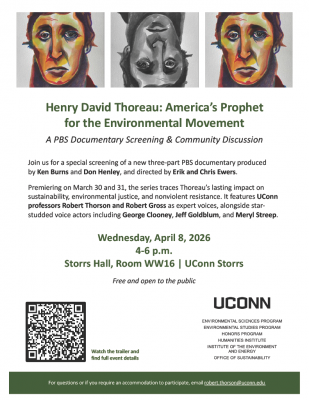
Henry David Thoreau: America’s Prophet for the Environmental Movement
There are no featured events coming up – check back soon!
Photo and Video Contest Submissions
Photo and Video Contest
Submit your entries for the photo and video contest here!
UConn Students in Belem: First Impressions from COP30
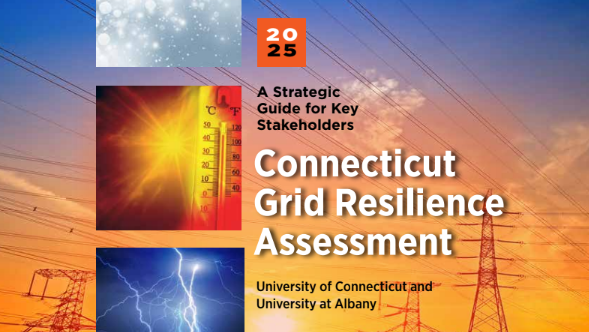
Research Highlight: 2025 CT Grid Resilience Assessment
Guest Lecture: A Novel Integrated Quantum Computing Approach for Unit Commitment
Guest Lecture: A Novel Integrated Quantum Computing Approach for Unit Commitment
As part of the Civil and Environmental Engineering Seminar series on Quantum Technology Applications for Engineering Systems, the School of CEE, and the Eversource Energy Center have co-invited Prof. Bing Yan, from Rochester Institute of Technology to give a guest lecture on “A Novel Integrated Quantum Computing Approach for Unit Commitment”, this Wednesday November 19 at 1 PM. The lecture will be held virtually. Please see the attached flyer for more information!