Photo and Video Contest
Submit your entries for the photo and video contest here!
Web cookies (also called HTTP cookies, browser cookies, or simply cookies) are small pieces of data that websites store on your device (computer, phone, etc.) through your web browser. They are used to remember information about you and your interactions with the site.
Session Management:
Keeping you logged in
Remembering items in a shopping cart
Saving language or theme preferences
Personalization:
Tailoring content or ads based on your previous activity
Tracking & Analytics:
Monitoring browsing behavior for analytics or marketing purposes
Session Cookies:
Temporary; deleted when you close your browser
Used for things like keeping you logged in during a single session
Persistent Cookies:
Stored on your device until they expire or are manually deleted
Used for remembering login credentials, settings, etc.
First-Party Cookies:
Set by the website you're visiting directly
Third-Party Cookies:
Set by other domains (usually advertisers) embedded in the website
Commonly used for tracking across multiple sites
Authentication cookies are a special type of web cookie used to identify and verify a user after they log in to a website or web application.
Once you log in to a site, the server creates an authentication cookie and sends it to your browser. This cookie:
Proves to the website that you're logged in
Prevents you from having to log in again on every page you visit
Can persist across sessions if you select "Remember me"
Typically, it contains:
A unique session ID (not your actual password)
Optional metadata (e.g., expiration time, security flags)
Analytics cookies are cookies used to collect data about how visitors interact with a website. Their primary purpose is to help website owners understand and improve user experience by analyzing things like:
How users navigate the site
Which pages are most/least visited
How long users stay on each page
What device, browser, or location the user is from
Some examples of data analytics cookies may collect:
Page views and time spent on pages
Click paths (how users move from page to page)
Bounce rate (users who leave without interacting)
User demographics (location, language, device)
Referring websites (how users arrived at the site)
Here’s how you can disable cookies in common browsers:
Open Chrome and click the three vertical dots in the top-right corner.
Go to Settings > Privacy and security > Cookies and other site data.
Choose your preferred option:
Block all cookies (not recommended, can break most websites).
Block third-party cookies (can block ads and tracking cookies).
Open Firefox and click the three horizontal lines in the top-right corner.
Go to Settings > Privacy & Security.
Under the Enhanced Tracking Protection section, choose Strict to block most cookies or Custom to manually choose which cookies to block.
Open Safari and click Safari in the top-left corner of the screen.
Go to Preferences > Privacy.
Check Block all cookies to stop all cookies, or select options to block third-party cookies.
Open Edge and click the three horizontal dots in the top-right corner.
Go to Settings > Privacy, search, and services > Cookies and site permissions.
Select your cookie settings from there, including blocking all cookies or blocking third-party cookies.
For Safari on iOS: Go to Settings > Safari > Privacy & Security > Block All Cookies.
For Chrome on Android: Open the app, tap the three dots, go to Settings > Privacy and security > Cookies.
Disabling cookies can make your online experience more difficult. Some websites may not load properly, or you may be logged out frequently. Also, certain features may not work as expected.
Submit your entries for the photo and video contest here!
Through the UConn@COP program, 12 UConn students attended COP30 (this year’s United Nations Framework Convention on Climate Change Conference of Parties, commonly referred to as COP) in Belém, Brazil. The conference, attended by word leaders, policymakers, climate researchers, and climate activists, is a transformative experience for students as they strive to become future leaders in climate science and policy. The fellows shared their initial impressions of the conference through blog posts that can be found on the UConn Office of Sustainability website, with some selections shared in an article for UConn Today.

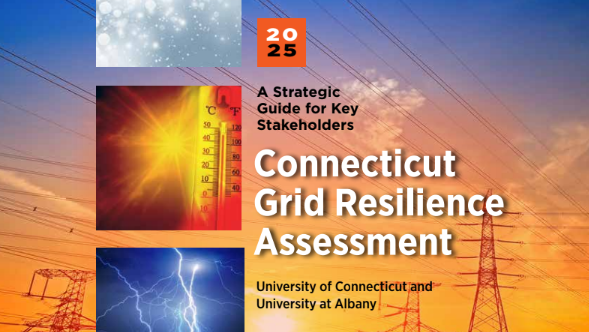
2025 Connecticut Grid Resilience Assessment
Produced by the University of Connecticut and the University of Albany, the Connecticut Grid Resilience Assessment (GRACI) Guide for Stakeholders synthesizes climate projections, outage data, infrastructure modeling, customer surveys, and social vulnerability metrics to identify Connecticut communities most at risk from extreme heat and high-wind-related outages.
As part of the Civil and Environmental Engineering Seminar series on Quantum Technology Applications for Engineering Systems, the School of CEE, and the Eversource Energy Center have co-invited Prof. Bing Yan, from Rochester Institute of Technology to give a guest lecture on “A Novel Integrated Quantum Computing Approach for Unit Commitment”, this Wednesday November 19 at 1 PM. The lecture will be held virtually. Please see the attached flyer for more information!

UConn Research Year in Review (2025)
The Year in Review report from the Office of the Vice President for Research (OVPR) highlights some of the initiatives at UConn that represent the groundbreaking research taking place at the University. Several IoEE faculty members, including affiliated faculty and Eversource Energy Center members, are noted in the report.
The University of Connecticut Central Utility Plant, which provides most of the energy used by UConn Storrs, is installing new turbines that can burn hydrogen as well as natural gas. The new turbines could reduce the facility’s carbon emissions by 30%, a key part of the University’s plan to be carbon neutral by 2030.
Professor Diego Cerrai (Assistant Professor in Civil and Environmental Engineering & Interim Director of the Eversource Energy Center), along with four other UConn faculty members, received the prestigious CAREER Awards from the National Science Foundation (NSF) during the 2025 cycle. The Faculty Early Career Development (CAREER) Program is a competitive award honoring early-career scientists and providing them with funding to support the continuation of their career.
Read the full article by Anna Zarra Aldrich (OVPR) on UConn Today

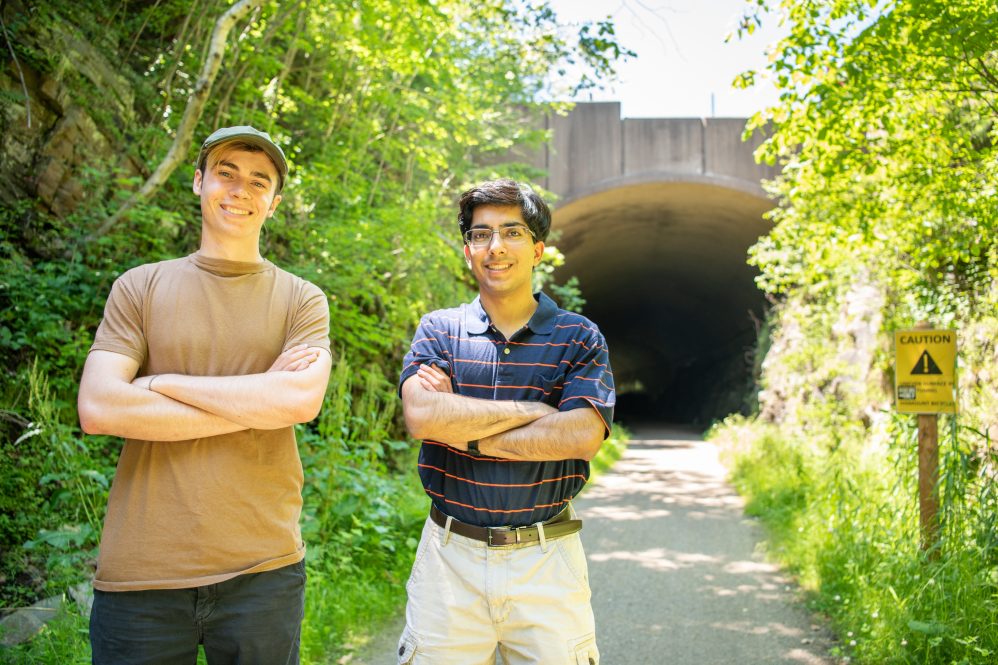
UConn students Robert Avena (left) and Sumeet Kadian (right) conducted a feasibility study during their first-year Service Learning class and recommended the installation of lighting through the Hop River Trail tunnel in Bolton Notch State Park (runs under Interstate 384 in Bolton, CT). The project, implemented by the Connecticut Department of Transportation (DOT) and the Department of Energy and Environmental Protection (DEEP), improves safety for bikers and pedestrians using the Hop River Trail.
Photo: Sydney Herdle/UConn Communications

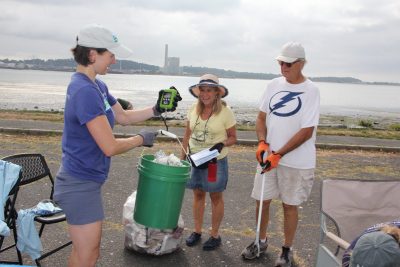
CT Sea Grant, UConn Extension, Anthropology, and Communications faculty are working on a two-year project to better prepare older residents for emergencies (pilot communities are Stamford, West Haven, and New London). The project includes roundtable discussions, listening sessions, and survey feedback to generate materials and programming to provide preparedness instructions, supplies, and other training to support senior residents and caregivers in the event of extreme weather.

From the SSN Website: "Connecticut SSN brings together a vibrant, engaged group of scholars from disciplines ranging from African American studies to political science to medicine to sociology. Although interested in a broad range of public policies, we focus particularly on challenges in three areas: economic and social inequality, health and health care, and criminal justice and child welfare."